
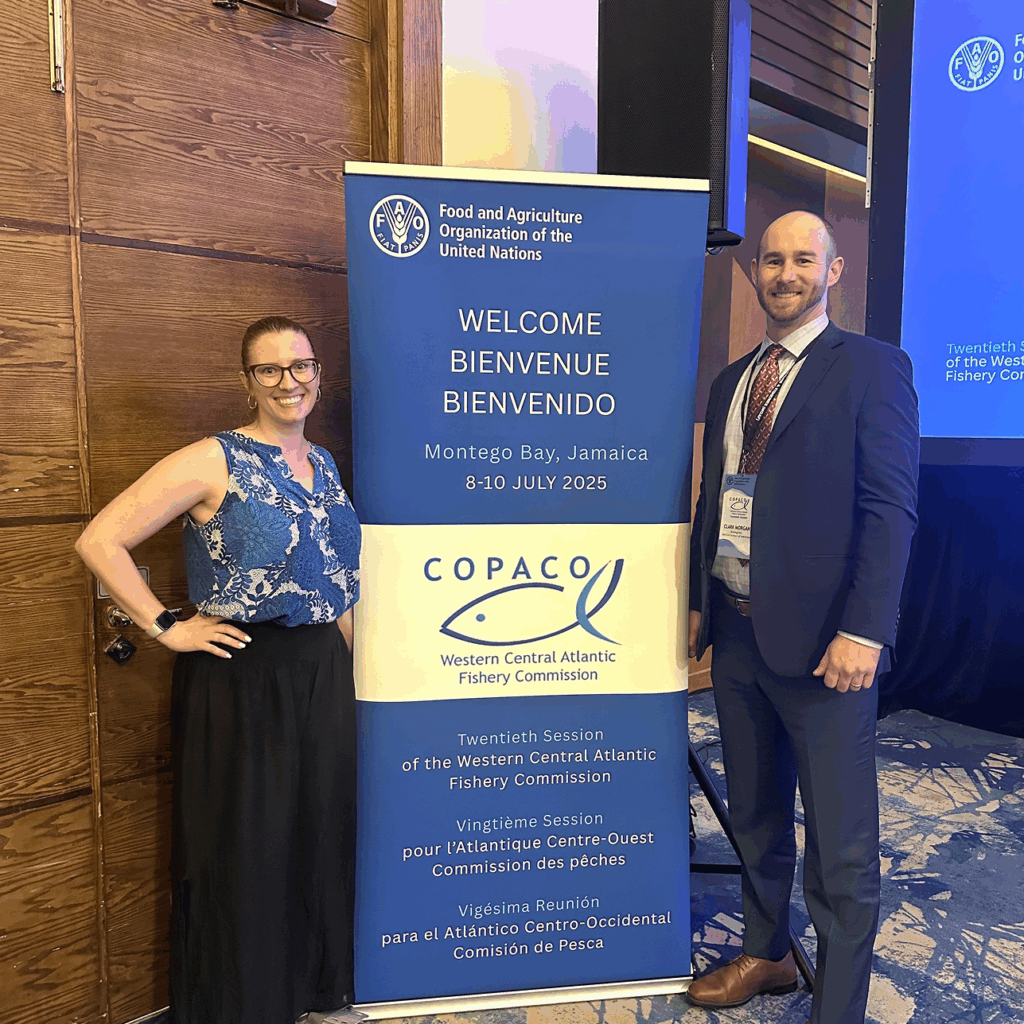
2025 Knauss Fellows Hayley Lemoine (left) and Clark Morgan (right) at the Western Central Atlantic Fishery Commission.
Hayley Lemoine is a 2025 Knauss Marine Policy Fellow at NOAA Fisheries. She previously served as Florida Sea Grant HARVEST intern and Aquaculture Communications Fellow.
It’s the first week of July and I’m standing in a spacious room filled with the din of many conversations, some hushed in pairs, others in cacophonous groups. Centered at the front is a giant, U-shaped table dotted with microphones and tidy, black-and-white name plates. I locate the plate that reads “United States” and make a beeline for it.
As part of my Sea Grant Marine Policy Fellowship at NOAA Fisheries, I had the opportunity to attend a regional fisheries body meeting for the Western Central Atlantic Fishery Commission . It is at regional fisheries meetings like this one where nations come together to negotiate the rules for who, where, when and how to harvest fish. Put simply, fish exist outside of geopolitical boundaries. The same fish might spend part of their life in the exclusive economic zone (EEZ) of one nation, before swimming through the high seas (i.e., “no man’s land”) into the waters of a different nation. This type of conundrum, and the complexity of political, ecological, and logistical questions it raises, is what regional fisheries management bodies serve to address.
Over the course of a week, I watched delegates from different nations negotiate the rules and rights to marine fisheries resources in the Caribbean and Western Atlantic. Though the official negotiations took place at the meeting table during scheduled times, the unofficial negotiations were non-stop. They took place in conversations over dinner and on the way to the bathroom, during whispered moments at coffee breaks and while chatting in line for a drink. Even within the delegation, there was a steady stream of constant communication as new information came to light, positions changed, and strategies were adjusted.
In this age of technological efficiency, where material goods are transported across the globe at remarkable speeds and AI is reshaping what it means to connect, I am struck by just how important human conversations and in-person interactions are to fisheries management. It seems clear to me that international cooperation cannot function via algorithm alone, because natural resources are (as their name implies), produced naturally. They can’t be generated by a really good 3D computer or the latest smart device. Common pool resources—that is, the goods and services provided by the environment that belong to everybody—are limited. There are only so many fish in the sea, and everyone wants some.
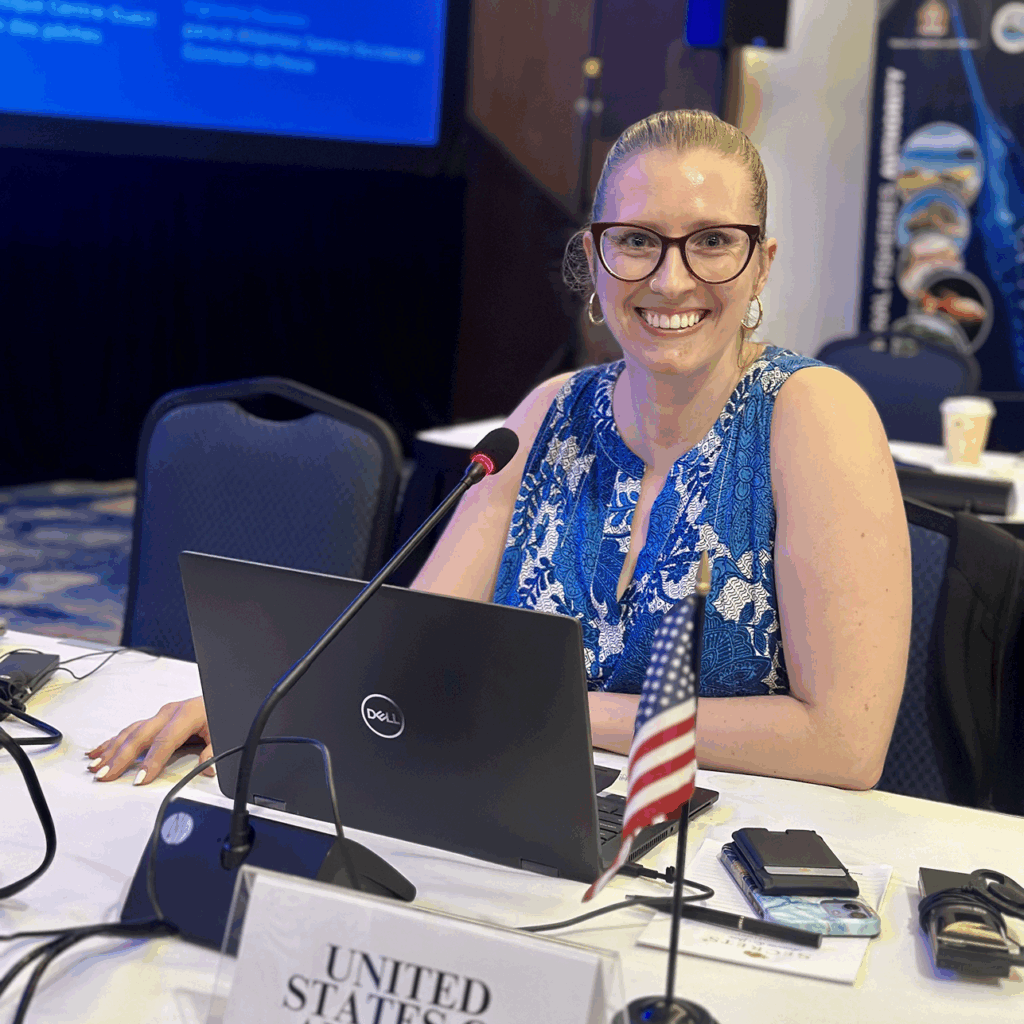 I learned that side conversations are critical. Personal relationships matter. The history of international fisheries policy and management isn’t just what was recorded in meeting reports or captured in the latest science or defined in law. It’s also in the last-minute discussions, the ability to navigate rules of procedure, the capacity to cultivate trust. At the end of the line, there are always people, not computers, making the final decision. People must approve the official text, make the final ruling, cast the deciding vote. International fisheries management is a multifaceted puzzle, a game of wits, and an exercise in teamwork. Nobody holds all the cards, and everyone has something to lose.
As I reflect on my week in Jamaica, I understand that technical expertise and scientific knowledge, while essential, are only part of successful negotiations. The ability to build relationships, read the room, and communicate effectively across cultures may be just as crucial to protecting shared resources. Our oceans may be governed by complex regulations informed by cutting-edge science, but they’re ultimately managed by people, with all the nuance, social acumen, and interpersonal skill that entails. Perhaps that’s the real art of international cooperation—balancing the technical with the deeply human.